We’re all familiar with the phases of the moon, going from new to full and back again with a period of just under 30 days. What might be a bit less obvious is that you can see the phase change over a single night.
A 360 degree phase change over 30 days is roughly 12 degrees per day. Over a good night’s observing, say about eight hours, that would mean that the sun’s light would cross about 4 degrees of the circumference of the moon. That ought to be visible, and indeed it is.
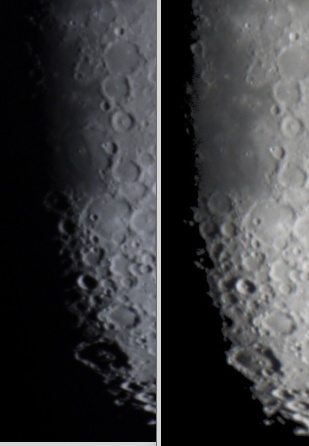
The following shows two images of the moon. The one on the left was taken at 5pm last night, 19th Jan. The one on the right was taken at 1am this morning, 8 hours later. Ignore the change in colour. The moon was close to the horizon in the right hand picture. It changes colour close to the horizon for exactly the same reason that the sun does: there’s more atmosphere to scatter the light.
Look at the area about a third of the way down from the top, close to where the light meets the dark. There’s a range of mountains running north-east to south-west. These are called the Apennine Mountains. They terminate in the south-west at a crater called Eratosthenes. The crater is clearly visible on the 1am picture, but is just emerging from the shadows in the 5pm one.

Here’s a closeup of the same two photos.The large crater at the bottom is called Clavius. Again, sunrise over Clavius is clearly visible.

I was hoping to catch Jupiter and the moon together earlier in the week but the field of view of my telescope and camera combination was just too small.

Instead, I stuck an old second hand zoom lens on the camera and caught this instead.

We’ve had beautiful clear skies here in Southend for the last week. Unfortunately, the moon’s been present for most of them. By the time it sets, there isn’t a lot left that my small telescope can see. Took a quick snap of the Beehive Cluster in Cancer though. (You have to use a bit of imagination sometimes to see anything remotely resembling their name in some objects.)





 Platitude of the Day